Artificial Intelligence (AI) is evolving faster than ever, transforming how businesses operate, how people work, and how technology shapes everyday life. In 2026, AI is no longer just a productivity tool—it is becoming an active digital partner capable of reasoning, planning, creating, and making decisions.
Whether you’re a business owner, content creator, student, developer, or technology enthusiast, understanding the biggest AI trends of 2026 can help you stay ahead of the curve.
1. Agentic AI Takes Center Stage
One of the most significant developments in 2026 is the rise of Agentic AI. Unlike traditional AI chatbots that simply respond to prompts, AI agents can plan, make decisions, use tools, and complete complex tasks with minimal human intervention. Industry analysts and technology leaders consider agentic AI the most important trend shaping the AI landscape this year.
Examples include:
- AI assistants that manage schedules and emails
- Automated customer support agents
- AI-powered software development teams
- Marketing agents that launch and optimize campaigns
Businesses are rapidly investing in AI agents to automate workflows, reduce costs, and improve efficiency.
2. AI Moves Beyond Chatbots
The AI revolution is moving beyond simple conversations. Modern AI systems can now interact with software, browse information, analyze data, generate reports, and execute multi-step tasks.
Instead of asking AI for answers, users increasingly ask AI to achieve outcomes such as:
- Building websites
- Creating marketing campaigns
- Managing projects
- Conducting research
- Generating complete business plans
This shift is transforming AI from a passive assistant into an active collaborator.
3. Multimodal AI Becomes the Standard
Multimodal AI can understand and generate multiple forms of content, including:
- Text
- Images
- Audio
- Video
- Documents
Rather than handling one type of information at a time, AI systems now combine multiple inputs to deliver more accurate and natural interactions.
For example, users can upload a photo, ask a question about it, receive a spoken explanation, and generate a video—all within the same AI platform. Multimodal capabilities are quickly becoming a standard feature of modern AI systems.
4. Smaller AI Models Gain Popularity
For years, bigger AI models dominated the industry. However, 2026 is seeing a growing shift toward Small Language Models (SLMs).
These smaller models offer several advantages:
- Faster performance
- Lower operating costs
- Reduced energy consumption
- Improved privacy
- Ability to run on local devices
Research suggests that smaller models can handle many business tasks nearly as effectively as large cloud-based models while requiring far fewer resources.
This trend is expected to accelerate AI adoption among startups, small businesses, and mobile device manufacturers.
5. AI-Powered Content Creation Explodes
Content creation continues to be one of the most impactful applications of AI.
In 2026, AI tools can generate:
- Blog articles
- Social media posts
- Marketing copy
- Images
- Videos
- Voiceovers
- 3D assets
Creators and businesses are increasingly using AI to scale content production while reducing costs and turnaround times. AI-generated video, in particular, is becoming a major growth area.
For bloggers, YouTubers, and digital marketers, AI has become an essential productivity tool.
6. AI Coding Assistants Become Everyday Tools
Software development is undergoing a major transformation.
Modern AI coding assistants can:
- Generate code
- Debug applications
- Explain programming concepts
- Create websites
- Build complete software projects
Even people with little technical knowledge can now create applications using natural language instructions.
This trend is accelerating the growth of no-code and low-code development, making software creation more accessible than ever before.
7. Enterprise AI Adoption Reaches New Heights
Organizations are moving beyond AI experimentation and integrating AI into core business operations.
Key areas of adoption include:
- Customer service
- Marketing automation
- Human resources
- Software development
- Data analysis
- Operations management
Studies show that most large organizations now use AI in at least one business function, while investment continues to rise across industries.
The focus is shifting from “trying AI” to achieving measurable business outcomes.
8. AI Governance and Security Become Critical
As AI systems become more powerful and autonomous, concerns about safety, security, and governance are growing.
Organizations are investing heavily in:
- AI monitoring systems
- Compliance frameworks
- Risk management processes
- Data privacy controls
- Responsible AI practices
Technology companies are increasingly treating advanced AI systems as potential security risks that require robust safeguards and oversight.
Responsible AI is no longer optional—it’s becoming a business necessity.
9. AI Personalization Reaches New Levels
AI is enabling highly personalized digital experiences.
Examples include:
- Personalized shopping recommendations
- Adaptive learning platforms
- Customized marketing campaigns
- Smart digital assistants
- Personalized healthcare support
Businesses are leveraging AI to deliver tailored experiences that improve customer engagement and satisfaction.
Consumers increasingly expect services that understand their preferences and adapt accordingly.
10. Human-AI Collaboration Defines the Future of Work
Despite concerns about job displacement, the dominant trend in 2026 is not humans versus AI—it’s humans working alongside AI.
Professionals who learn how to effectively use AI are becoming significantly more productive. AI is helping workers:
- Automate repetitive tasks
- Improve decision-making
- Generate ideas faster
- Analyze information more efficiently
- Focus on higher-value work
The most successful individuals and organizations will be those that learn how to combine human creativity with AI capabilities.
Final Thoughts
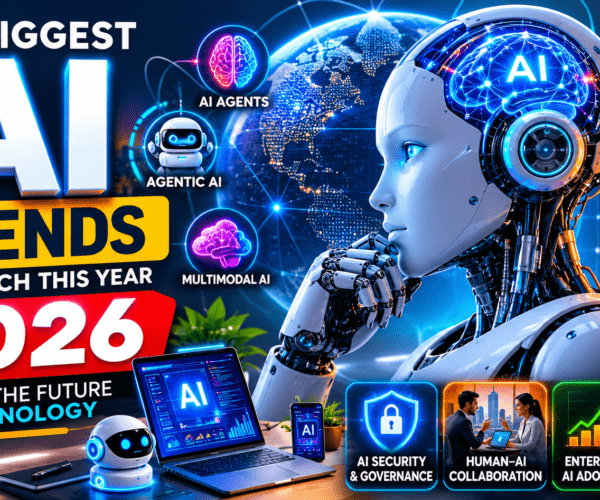
The AI landscape in 2026 is defined by autonomy, intelligence, and integration. Agentic AI, multimodal systems, small language models, enterprise adoption, and responsible AI governance are shaping the next generation of technology.
For businesses, the question is no longer whether to adopt AI, but how quickly they can integrate it into their operations. For individuals, learning to work effectively with AI may become one of the most valuable skills of the decade.
As AI continues to evolve, those who stay informed and adapt early will be best positioned to thrive in the future digital economy.